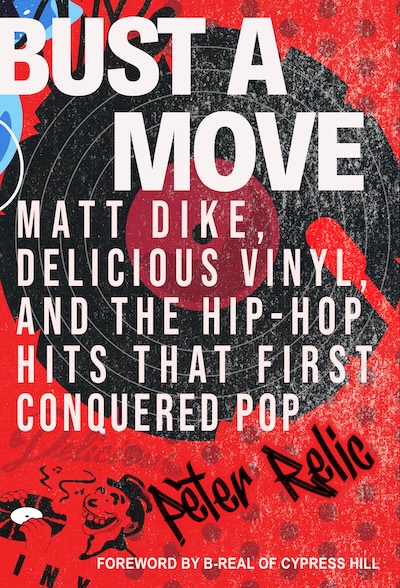
Founded by Michael Ross and Matt Dike in 1987, Delicious Vinyl marked the height of a brief, heady love affair between funky golden-era hip-hop and the MTV generation at the dawn of the Nineties. It was the first hip-hop label to score three Billboard Hot 100 top 10 singles, all in 1989: Tone Loc’s “Wild Thing” and “Funky Cold Medina,” and Young MC’s “Bust a Move.” As Peter Relic explains in Bust a Move: Matt Dike, Delicious Vinyl, and the Hip-Hop Hits That First Conquered Pop, much of its success was due to Dike, a talented DJ who refined a distinct mash of scratchy, gut-bucket funk and Seventies hard rock boogie into kinetic club hits. “For a fleeting, shining time, aligned with a stunning series of collaborators, Matt Dike had been the hottest music producer in the world,” writes Relic, who recreates a Los Angeles era filled with colorful figures, from John Hughes to Jean-Michel Basquiat, that help fuel Delicious Vinyl’s precipitous rise. The book ends with Relic tracking down Dike, who also co-produced Beastie Boys’ 1989 masterwork Paul’s Boutique as a member of the Dust Brothers before his erratic behavior fomented a nasty breakup with Ross and a permanent retreat from the public eye. The two engaged in a rare interview just before Dike passed away in 2018.
Relic, a veteran music journalist who has written for innumerable outlets ranging from Nineties cult favorites Grand Royal magazine to Complex Networks, is currently the public relations writer for Savannah College of Art and Design in Savannah, Georgia. He answered some questions about Bust a Move via email.
Folks who read Bust a Move will undoubtedly wonder why you cut off the narrative when Matt Dike left Delicious Vinyl in 1993 and without mentioning subsequent stars like Masta Ace Incorporated and the Yancey brothers or even classic albums like Labcabincalifornia. Do you believe that the label became less relevant after Dike’s departure? Is it possible to get a complete story of the label without mentioning the Mike Ross-led years?
I’m a fan of the Nineties era of Delicious Vinyl, including Masta Ace Incorporated’s SlaughtaHouse and Sittin’ on Chrome, and groups like Whoridas and The Wascals. Illa J’s album Yancey Boys from 2008 is a magical collaboration between brothers across time, a Dilla joint to treasure. To write a comprehensive encyclopedia of the label would be a different kind of book that would appeal to a certain type of completist. I wanted to focus on the founding era of Matt Dike and tell a compelling story of a crucial moment in time.
The Delicious Vinyl story is a very LA-driven tale with plenty of celebrity cameos. The hip-hop scene there doesn’t seem as insular as it was in New York and Miami, by comparison. How did its star-crossed nature affect the music?
One tenet of the book is to show what Los Angeles was like in the Eighties and how the nightclub scene created a specific set of conditions that allowed Delicious Vinyl to thrive. You’ve got these cross-pollinating subcultures including skateboarding and breakdancing and goth and drag and punk all happening together. That led a mixed mentality and different kinds of people collaborating on the cusp of stardom. Flea from the Chili Peppers playing bass on “Bust a Move” being case in point.
You wrote that Body and Soul recorded an album and the master tapes are in a storage locker. [The duo featured Dee Barnes of Pump It Up fame and Rose Hutchinson, and only released one single, 1989’s “Dance to the Drummer’s Beat.”] Where’s the storage locker? Has anyone tried to retrieve it and prepare it for release? I imagine there’s lots of samples on it that would need to be cleared, but that hasn’t stopped EU labels from doing a brisk trade in licensing those kinds of albums for collectors.
It would be wonderful if someone undertook that challenge. Here’s hoping it happens.
One figure that often shows up in Bust a Move is Rick Rubin. He comes off as mercurial and difficult, which isn’t surprising given his public reputation back then. What’s his connection to Delicious Vinyl and Mike Ross and Matt Dike? Were they friends, rivals or a bit of both?
I don’t think any of them would have thought of it as a rivalry. Other execs at Def Jam might have been miffed at Delicious Vinyl’s success, but I think Matt Dike and Mike Ross were just busy making records they loved. Certainly, Matt and Mike were in awe of the sound of those early Rick Rubin productions, from [T La Rock’s] “It’s Yours” to [Run-DMC’s] “It’s Tricky.” Rubin was friends with Matt Dike. Mike Ross too. In the book, Dike speaks about his relationship with Rubin, his love of Rubin’s production style, and his astonishment the first time he heard [Beastie Boys’] “Time to Get Ill.”
Race is a subtle theme that runs through Bust a Move, whether it’s Mike Ross and Matt Dike bragging about their bona fides as Black music fans or Dike claiming that Tone Loc doesn’t qualify as a “gangster” because he’s middle class. Why did you choose to render those moments as part of the general action, so to speak, instead of pausing to analyze them?
It’s up to the reader to determine the significance of those moments.
I noticed that you didn’t talk about Cool Hand Loc even though Matt Dike produced tracks for it. How does that album fit into the Delicious Vinyl story?
I was less interested in Cool Hand Loc because it’s a less interesting album. By that point, the popular rise of gangsta rap made an artist like Tone (who’d already had crossover pop hits) seem less relevant. The fact that the album was not particularly successful commercially also made it clear that the initial lightning-in-a-bottle era of Delicious Vinyl was over.
You spend some time talking about the greatness of Delicious Vinyl’s biggest hits, and I agree that Loc’ed After Dark and Stone Cold Rhymin’ deserve more critical respect. Why do you think that Delicious Vinyl’s Eighties pop peak doesn’t get more attention from golden-era rap fans? They’ve found a place for New Jack stars like Salt-n-Pepa, Heavy & The Boyz and Kool Moe Dee, but they seem to ignore the likes of Tone Loc and Mellow Man Ace.
A number of factors. Number one is that New York-based media looks after its own, then and now. The other is the blinding nature of the “pop peak” you mention. The afterglow tends to cast Tone Loc and Young MC in with the other pop wonders of their era, rather than rightfully praised as hip-hop artists. The book aims to rectify that. And I agree that Mellow Man Ace should also be exalted – any Cypress Hill fan unfamiliar with the backstory can go listen to Mellow Man’s 1989 album Escape from Havana and be in for a treat.
The final interview with Matt Dike appears to be verbatim. How did you record the interview? Was it through longhand or recording him via tape? Did you pursue a follow-up interview afterward and were you successful or unsuccessful?
I recorded my interview with Matt Dike with a hand-held digital voice recorder. I visited him on a subsequent afternoon at his house, where he shared with me some of the items he had kept, including mix tapes, answering machine cassettes, photos, and flyers from clubs including Power Tools. Some of the ephemera found its way into the book.
Circling back on the question of racial issues within Delicious Vinyl – do you think those interactions you described in the book are important or irrelevant to its history? Also, did you find that Delicious Vinyl developed differently because of its polyglot musical nature and two white owners as opposed to, say, other local indies like Egyptian Empire and Techno Hop Records?
Yes, those interactions are relevant. Def Jef, on the verge of signing a deal with Ice-T’s Rhyme Syndicate, hears one of Dike’s beats, and wants to meet Dike and Ross, to make sure there’s nothing “funny or forced” going on with these two white dudes. He winds up signing with Delicious Vinyl. Again, I wanted the reader to have their own chance to assess and interpret the significance of race in the story.
While doing research, I found a great article Bonz Malone wrote in SPIN in July 1990 (“Planet Janet Rock”) where he flies to LA to meet Matt Dike and Mike Ross. Bonz has a bone to pick with Delicious Vinyl’s white owners. It’s worth reading.
I agree, Delicious Vinyl developed its own way, with its own sound, in part due Dike’s omnivorous devotion to record collecting. The break away from the LA sound popularized by Egyptian Lover and [Techno Hop owner] Unknown DJ is detailed in the chapter “Pool Cues.” One key was Dike and Ross hearing the then-new rap records coming from New York and feeling (and being inspired by) that sound…then putting their own split-finger spin on it.
One of the aspects of hip-hop’s development that you nudge at is that the energy around its culture was different before “gangsta rap” arrived at the beginning of the Nineties, even when it came to self-serious rappers like Rakim. Can you describe that feeling a bit? There are plenty of comparisons between Tone Loc and Rakim’s vocal tone, but I found those amusing since, in terms of delivery and reputation, they’re quite different.
Before rap music blew up commercially, the range of styles seemed both wider and wilder. That was the Eighties. Creative boundaries were being pushed, while the record industry still wasn’t sure what’s going to sell. Then there’s a moment when a fork in the road appeared. Then there’s “underground” hip-hop and more popular stuff. Still, those lanes wind up overlapping in expected ways, which is what makes the Nineties some people’s favorite era. Delicious Vinyl spans both eras. With the book, I wanted to bear down on a time when what was possible – and popular – seemed up for grabs.
I agree, the comparison between Tone and Rakim is all down to their vocal range. They both sound quite a bit like Alfred Hitchcock, if you ask me.
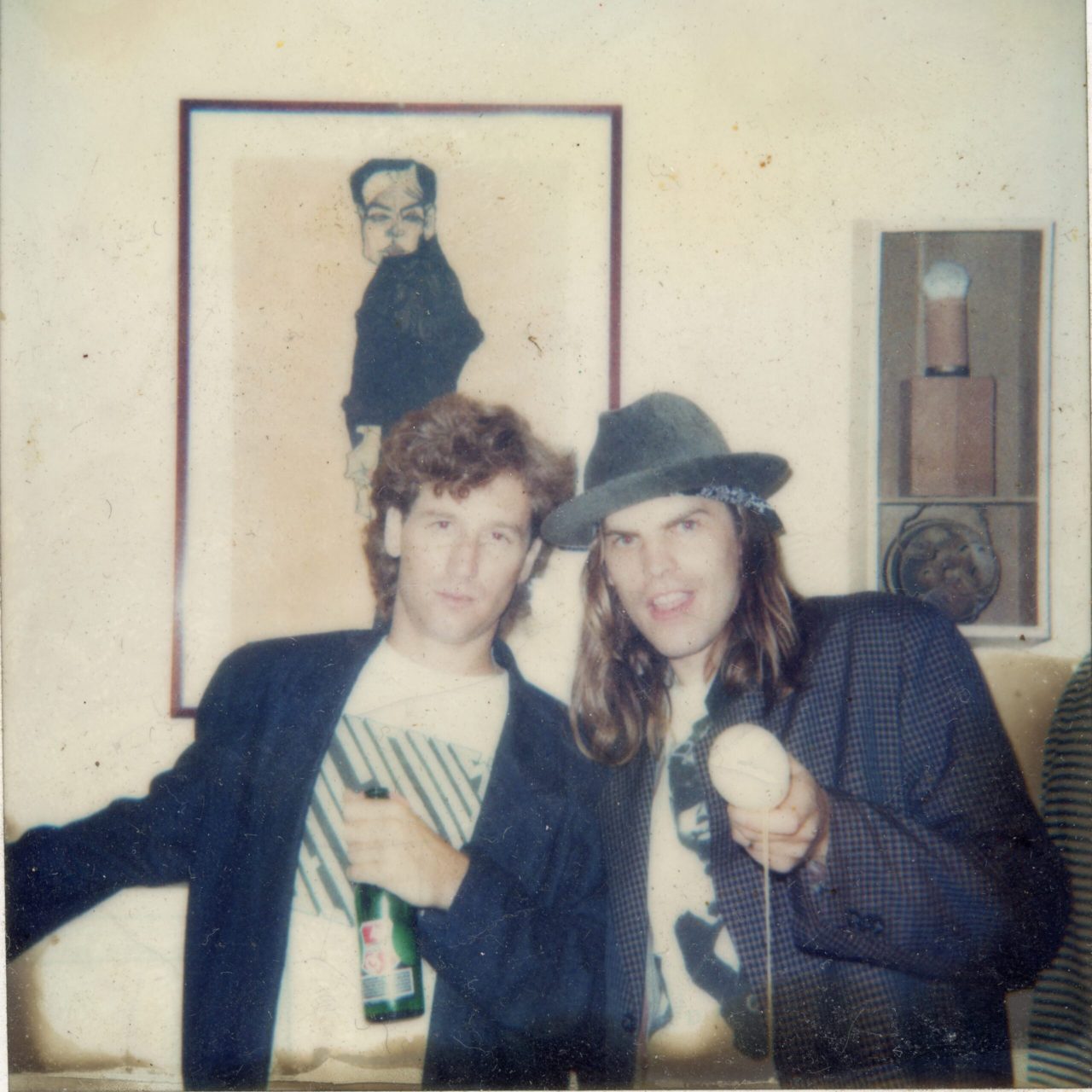
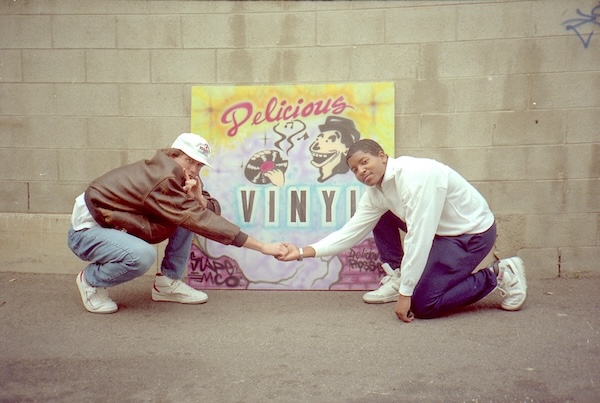
Featured photo of Michael Ross and Matt Dike courtesy of Delicious Vinyl.
Humthrush.com will always be free to read and enjoy. If you like my work, leave a tip at Ko-fi.com/humthrush.